Molly Mutt Europe — Meta Advertising
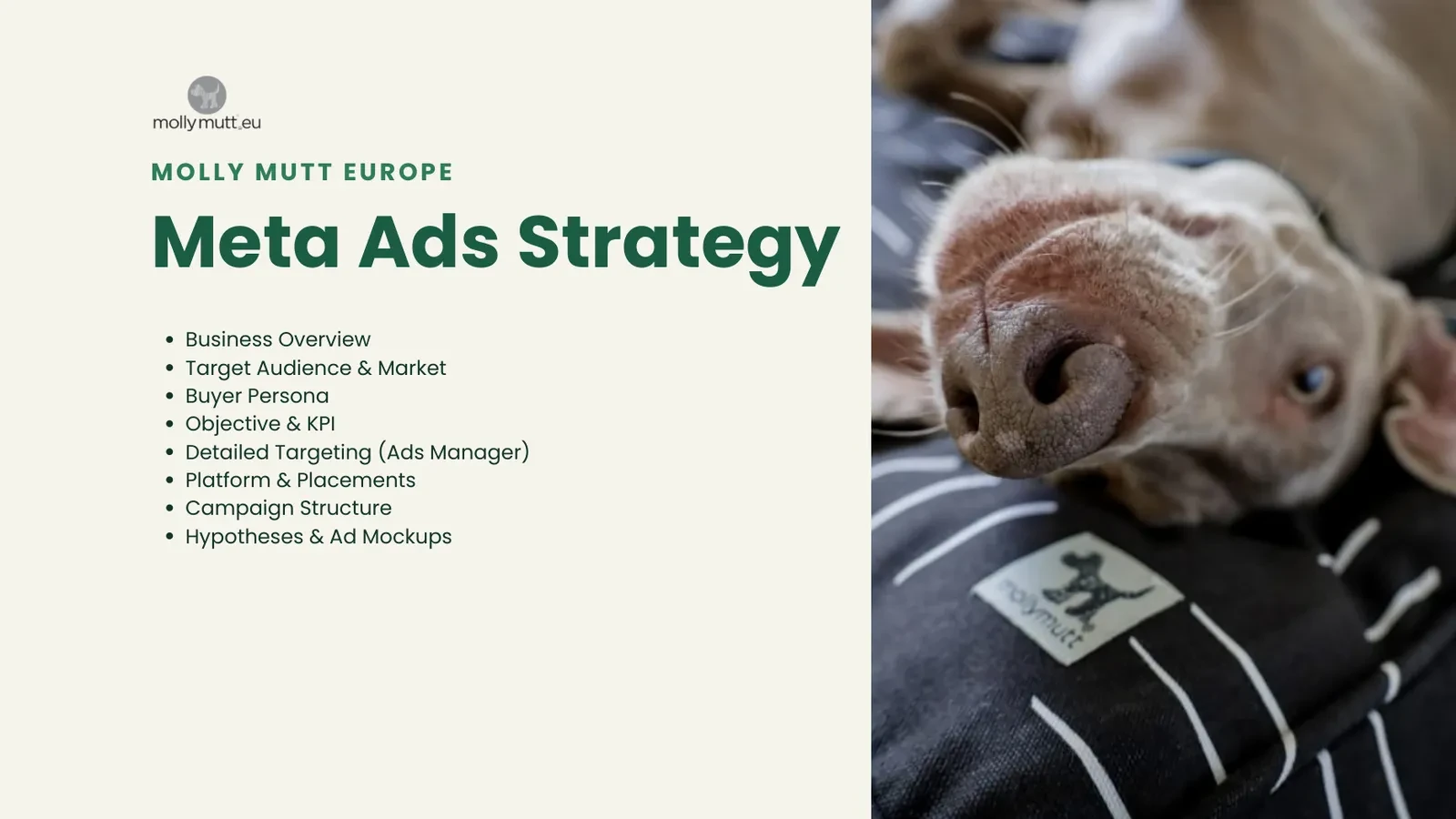
A traffic campaign concept for sustainable dog bed covers in Germany: audience research, one tightly defined ad set, and four creatives built to test which hook earns the click.
- My role
- Bilingual ad copy (EN/DE), audience research and buyer persona, A/B test logic
- Team
- 3 DCI students
- Status
- Campaign plan, not launched
01Project overview
Molly Mutt Europe sells dog bed covers that owners stuff with old clothes and pillows instead of buying new filling. For a DCI group assignment, three of us planned a two-week Meta campaign for the German market: who to reach, what to say, and how to find out which message works.
The plan was built for a €300 budget and a planned flight of 5–18 October 2026. Everything on this page is planning work. I am not reporting any campaign results.
02Business challenge
A solo-run brand with a small paid budget needs to explain an unusual idea — “stuff the bed with what you already own” — to people who have never heard of it. €300 over two weeks is too little for Meta to optimise towards purchases, so the campaign had to pick a goal it could actually learn from.
03Target audience
- Dog owners in Germany, all genders, aged 25–55
- Already live sustainably: recycle, buy organic, avoid fast fashion
- Trust verified certifications such as GOTS and Oeko-Tex more than green marketing language
- Frustrated by “eco-friendly” claims that nobody can check, and by sustainable pet products that look cheap
- Built in Ads Manager as an Advantage+ audience: dog-related interests, Engaged Shoppers, mobile users — estimated size 63,800–75,000 (Ads Manager, 24 Sept 2026)
04Campaign objective
Website traffic. Bring eco-minded dog owners in Germany from Facebook and Instagram to mollymutt.eu so they can learn about the upcycling concept. Primary KPI: cost per click, measured through landing page views and UTM-tagged sessions in Google Analytics.
05Strategy and approach
- One campaign, one ad set, four ads. Because every ad competes for the same people, a winning ad wins because of the creative, not the targeting.
- Placements on Facebook and Instagram Feed, Stories and Reels — Facebook for cheaper reach, Instagram for a design-conscious audience.
- Hypothesis 1, recycling angle: a video shows old clothes becoming a bed, so it should earn more engagement than a static image. Two video hooks were prepared: a statement (“Every year, old dog beds end up in… landfill”) and a question (“Where does your old dog bed end up?”).
- Hypothesis 2, trust angle: a carousel led by an independent product test gives proof people don’t have to take on trust. Two carousels use the same four cards in a different order — social proof first versus sustainability first.
- Creatives were adapted from assets that already exist in the brand’s library, keeping production cost near zero.
- Every ad carries its own utm_content value so each hook can be read separately in Google Analytics.
06My individual contribution
- Worked in a team of three DCI students; we shared research, structure and presentation.
- Contributed to the audience research and buyer persona.
- Wrote ad copy in English and German: five primary texts, five headlines and five descriptions, each checked against Meta’s character limits.
- Helped define the A/B test logic: change one thing per test so the result can be explained.
- Presented part of the strategy to the class.
07Creative samples and screenshots
Buyer persona: the eco-minded dog owner in Germany Objective and target benchmarks (targets, not results) Audience setup in Meta Ads Manager One campaign, one audience, four ads Video variants: statement hook vs. question hook Carousel A/B test: social proof first vs. sustainability first Carousel mockups in the Facebook and Instagram feed Primary text: five ways to say “reuse” The campaign on one slide
08Tools used
09KPIs
Target benchmarks — planning values, not results
- Planned budget, 5–18 Oct 2026
- €300
- Target cost per click
- €0.45–0.60
- Target clicks
- 500–665
- Target CTR, as a secondary health check
- > 2%
These are targets set during planning. No performance data is reported on this page.
10Key learnings
- Budget determines the campaign objective. With €300, a traffic objective gives Meta enough signals to optimise; a purchase objective would not generate sufficient conversion data.
- Testing one audience and one variable at a time keeps results clear and easy to attribute.
- Audiences that are sceptical of sustainability claims respond to proof they can verify. This mirrors my experience in hospitality: guests trust other guests more than the brochure.
- Writing bilingual ad copy within strict character limits requires reducing the message to its single most important idea.
Want to talk about this project?
I’m happy to walk you through the thinking behind it.